In late 1969, the case took an unexpected turn as homicide detectives began focusing on a group known to frequent Sunset Boulevard and the Sunset Strip around the same time Marina Habe did. On December 12, 1969, a newspaper article appeared with the headline: Same Tate Murder Knives Believed Used in Girl Case.
The opening of the article read: “The teen-age daughter of screenwriter Hans Habe may have been slashed to death by the same knives that killed actress Sharon Tate and six others, it had been learned today.”1
Following the Manson Family’s arrest for the Tate-LaBianca murders, investigators intensified their investigation into the Marina Habe case, suspecting that Manson’s followers might have been involved in her death.
But did the Manson Family truly play a role in Marina Habe’s murder, or was this narrative fueled by sensationalism? Let’s delve into the facts and separate truth from fiction.
Welcome to Manson territory
Marina Habe graduated from University High School in West Los Angeles in June 1968, placing her in the vicinity of many of the routes the Manson Family traveled at that time. This was when Manson mingled with celebrities like the Beach Boys and Terry Melcher on Sunset Boulevard.
The young man Marina had a date with on the night she disappeared, John Hornburg, lived surprisingly close to the Manson Family on Sunset Boulevard during the spring and summer of 1968; their addresses were separated by a three-minute drive.
Marina Habe lived just a one-minute drive from the Whisky a Go Go. It was at this iconic nightclub that Charles Manson famously cleared the dance floor with his gyrating dance moves during a visit in the summer of 1968.
Even more significantly, Manson Family member Charles ‘Tex’ Watson—one of Sharon Tate’s killers—lived just around the corner from Marina in West Hollywood in early 1968, before he joined the Manson Family. Their addresses were only a four-minute walk apart.
Marina had also dated someone with ties to the Manson Family: the brother of Sonic Youth singer Kim Gordon, who was acquainted with Bobby Beausoleil, a member of the Manson Family. Beausoleil was later convicted of what became known as the first Manson Family murder.
These numerous connections raise the question: Was Marina Habe merely in the wrong place at the wrong time, or was she a specific target? To explore this further, we must first establish her whereabouts during the spring and summer of 1968.
Marina Habe’s Whereabouts in 1968
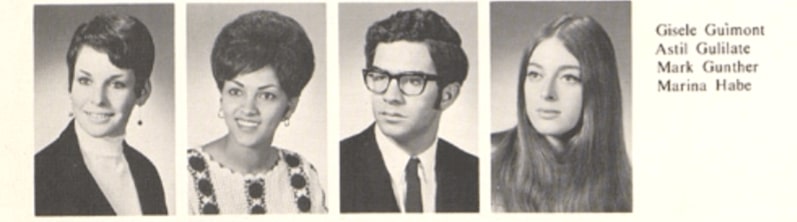
Marina Habe lived in West Hollywood from at least 1962 and remained there throughout her high school years. Marina attended Bancroft Junior High, which fed into Fairfax High School. She spent two years at Fairfax, located on Melrose Avenue, before transferring to University High School in West Los Angeles.
Marina graduated from University High in June 1968.2 She completed her exams in May, with the graduation ceremony taking place in June. Marina’s photo appears on page 154 of the 1968 University High yearbook.
At University High, where Marina spent her final two years, she was in close proximity to several future Manson Family members before they joined the group. Notably, one member involved in the Tate-LaBianca murders also attended University High—the same school as Marina. More on that later.
After graduating from University High School in June 1968, Marina attended the University of Hawaii. As a freshman, she likely began her first semester in late August or early September 1968, which is the typical start of the academic year.
In January 1969, her father, Hans Habe, informed reporters that he had last seen Marina during the summer of 1968. Although Marina frequently visited her father in Switzerland, it remains unclear whether Hans had traveled to the United States that summer or if Marina had made a trip to Switzerland herself.
Given that Marina’s graduation ceremony took place in June 1968, it seems reasonable to assume that Hans likely traveled to the United States to attend the event—especially considering the close bond he shared with his daughter and his frequent travel between the U.S. and Europe.
If Hans visited the U.S. for her graduation, it is highly probable that Marina was also in the U.S. during the summer of 1968.
This timeline places Marina Habe in Los Angeles during the spring and early summer of 1968, and possibly throughout the summer until late August. This confirms she was in close proximity to the Manson Family during that time frame.
With Marina living in Los Angeles during this period, the overlap with the Manson Family becomes more than just coincidental—it becomes geographic. One key location where these worlds may have brushed up against each other was Sunset Boulevard.
The Sunset Boulevard Connection
Sunset Boulevard, a legendary street synonymous with Hollywood glamour, played a crucial role in the Manson Family saga. Manson and his followers frequently visited the home of Beach Boys drummer Dennis Wilson, located at 14400 Sunset Boulevard. Manson and his clan even lived there for a period during the spring and summer of 1968.3
John Hornburg, Marina Habe’s date on the night she disappeared, lived just a short distance away at 13326 Sunset Boulevard. The distance between 14400 and 13326 Sunset Boulevard is approximately a 3-minute drive.
As a 1969 newspaper article reported, “Police said Miss Habe left her home Sunday to meet her date for the evening, John Hornburg, 22, at his house at 13326 Sunset Blvd.”4
Manson Family member Tex Watson wrote that while staying on Sunset Boulevard, the Manson girls did garbage runs at supermarkets in both the Brentwood and Palisades areas. The Brentwood area includes a section of Sunset Boulevard where John Hornburg lived. Watson further mentioned that he regularly drove the girls on these garbage runs.5
The Manson Family regularly passed by Hornburg’s home on their route between Dennis Wilson’s home on Sunset Boulevard and Spahn’s Movie Ranch, another Manson Family hangout. Marina Habe’s body was discovered near the route the Manson Family would have taken from Spahn Ranch to Sunset Boulevard.
It is important to note that, at this time, the Family actively recruited young people like Hornburg and Habe. While it is now known as a murderous cult, the Manson Family was once a very social group, constantly attracting new people. Marina Habe herself was known to be sociable, as evidenced by the 350 people who attended her funeral.6
The Hornburg Family Connection
The possibility of Marina Habe and John Hornburg encountering someone from the Manson Family increases due to potential connections through Hornburg’s father, Charles Hornburg. He likely sold a car to music producer Terry Melcher and possibly serviced Dennis Wilson’s Rolls-Royce.
The Manson group was associated with both Melcher and Wilson, and Manson Family members were known to have driven both Melcher’s and Wilson’s cars7.
Charles Hornburg was a prominent figure in the Los Angeles car scene, owning a luxury car dealership at 9176 Sunset Boulevard. He became the first importer of Jaguars into the United States and served high-profile clients, including Clark Gable, Frank Sinatra, and Jayne Mansfield.
Terry Melcher, the music producer who lived at 10050 Cielo Drive (the house where Sharon Tate was killed), owned a 1968 Jaguar XKE.8 As Hornburg was the primary Jaguar dealer west of the Mississippi, it’s highly likely Melcher purchased his Jaguar from Hornburg.9
Here is a 1968 advertisement for the 1968 Jaguar XKE that Terry Melcher owned; note the name and location of the dealership: Hornburg—9176 Sunset Blvd.
Charles ‘Tex’ Watson, one of the Manson Family members convicted of the Tate-LaBianca murders, even borrowed Terry Melcher’s brand-new Jaguar in 1968, along with Manson Family member Dean Moorehouse, several months before Marina Habe’s murder.10
Besides Jaguars, Hornburg also handled the sales and maintenance of Rolls-Royces. This raises the possibility of a connection with Dennis Wilson, who owned a Rolls-Royce and lived near Hornburg’s dealership.11 Wilson lived at 14400 Sunset Blvd, while Hornburg’s car dealership was located at 9176 Sunset Blvd. Here is a 1966 job posting where Hornburg was looking for mechanics with experience in Jaguars and Rolls-Royces.
Tex Watson met Charles Manson after picking up Dennis Wilson, who was hitchhiking on Sunset Boulevard. Both of Wilson’s cars, including his Rolls-Royce, had been wrecked. Given the limited number of places specializing in Rolls-Royce service at the time, it’s plausible that Wilson brought his car to Hornburg’s for repairs.12
The Manson Family was known to use Wilson’s Rolls-Royce for various activities, including dumpster diving. Dianne Lake, a former member of the Manson Family, recounted, “That is how we wound up driving in Dennis’s burgundy Rolls-Royce to the back of a grocery store and showed him the art of dumpster diving.”
In Ed Sanders’ 1971 book The Family, one of the earliest works about the Manson Family, a former associate of the group claims that Marina Habe was known by its members, a rumor that Vincent Bugliosi repeats in his 1974 book Helter Skelter.13
So many chance encounters led to the murder of Sharon Tate. Could a random meeting with the Manson Family have cost Marina Habe her life?
Given how interconnected we all are, this wouldn’t be surprising. For example, Dennis Hearst, who delivered a bike to Sharon Tate’s residence on the night of the murders, was Marina Habe’s lab partner in biology class.14
Interlude: Connections to Sharon Tate
Marina Habe lived just an 8-minute drive from 10050 Cielo Drive, the house where Sharon Tate was killed. Marina had her funeral service—a Requiem Mass—at the same church as Sharon Tate (Good Shepherd Church), and she is buried in the same cemetery as Sharon Tate (Holy Cross Cemetery).15
The Gordon Connection
“In high school, one of my brother’s ex-girlfriends, Marina Habe, was allegedly killed by the Manson Family.” (Gordon, Girl in a Band, 2015)
Before dating John Hornburg, Marina Habe had dated Keller Gordon, the brother of Kim Gordon, the singer of Sonic Youth. According to Kim, her brother was acquainted with Bobby Beausoleil, who was part of the Manson group.
Gordon wrote in her book, that Keller had met Beausoleil at a house in Topanga Canyon: “Keller used to crash sometimes at a house at the foot of Topanga Canyon, where one night he met another Manson Family member, Bobby Beausoleil. Bobby would say repeatedly, ‘You should come over to the ranch sometime.’”
This encounter likely occurred in the first half of 1968, after the Manson Family had moved to the Spahn Ranch. Prior to that, the Family had lived at the Spiral Staircase house, located in the lower part of Topanga Canyon. The Spiral Staircase house was a crash pad for anyone needing a place to stay.16
After leaving the Spiral Staircase house, the Family moved to a location on Fernwood Street, Topanga Canyon, before eventually relocating to Spahn Ranch.17 However, Beausoleil likely met Keller at the Spiral Staircase house, which was a popular hangout for locals. In fact, the Family eventually moved out of the house because it became too crowded with visitors.
While the Family eventually moved to Spahn Ranch, Beausoleil frequently visited Topanga Canyon. In fact, Beausoleil committed the murder of Gary Hinman in Topanga Canyon.
Bobby Beausoleil, a promising young musician who had worked with Frank Zappa, was convicted of Hinman’s murder, which he committed alongside Susan Atkins and Mary Brunner. Charles Manson, who slashed Hinman’s face with a sword, and fellow Manson Family member Bruce Davis were also convicted for the crime. Beausoleil was sentenced to death, but the sentence was later commuted to life in prison. He is still serving his sentence today.
“It wouldn’t be long before the Manson murders exposed the darker side of the city, and they also touched the Gordon household. Marina Habe, an ex-girlfriend of Kim’s older brother, Keller, was found brutally slain in January 1969. It has long been speculated that she was an early victim of the Manson Family.” Excerpt from a L.A. Magazine article.18
Connections between Marina Habe and people in Manson’s orbit continue to surface—not just geographically, but through schools and social circles. One such link involves a fellow student who would later become infamous.
The Krenwinkel Connection
Marina Habe and Manson Family member Patricia Krenwinkel share a surprising connection: they both attended University High School in West Los Angeles. Krenwinkel graduated in June 1966, while Habe graduated two years later, in June 1968. Krenwinkel’s University High School diploma19 ironically states that she had been “found worthy in character and citizenship” — a statement that, considering her later actions, hasn’t aged well.
Patricia Krenwinkel was later convicted for the Tate-LaBianca murders, which she committed with Tex Watson, Susan Atkins, and Leslie Van Houten. Krenwinkel was sentenced to life in prison, a sentence she is still serving today, although she has been recommended for parole.
As we continue tracing potential links between Marina Habe and the Manson Family, another key figure emerges—one whose name is synonymous with the group’s most brutal crimes.
The Tex Watson Connection
Tex Watson was the Manson Family’s primary killer. He was responsible for the Tate-LaBianca murders and the murder of Donald Shea—eight victims in total, nine if you include Sharon Tate’s unborn baby. Could Watson, the Manson Family’s chief executioner, have personally encountered Marina Habe?
It has long been rumored that Watson had met Habe. Interestingly, there are parallels between them that warrant further examination. Both lived in the same neighborhood, and were in the same vicinity from the fall of 1967 until at least early summer 1968.
Additionally, Watson was in Los Angeles at the time of Marina Habe’s murder. During this period, Watson had left the Manson Family for several months and was on his own.
The Love Locs Wig Shop
While Tex Watson is primarily known for his role in the Manson Family murders, his activities before joining the group place him in close proximity to Marina Habe.
When Watson arrived in Los Angeles from Texas in 1967, he enrolled at Cal State and began his first classes in September. To support himself, he took a job as a wig salesman at Continental Wigs, where he sold wigs and canvassed the streets, distributing business cards to women to attract them to the shop.
Not long after, Watson opened his own wig shop, ‘Love Locs,’ located at the intersection of San Vicente Boulevard and La Cienega Boulevard in Beverly Hills. The shop was just 1.4 miles from Marina Habe’s home.20
Wonderland Drive
As his life in Los Angeles intensified, Watson’s world shifted from selling wigs to a more chaotic lifestyle. In early 1968, Tex Watson lived on Wonderland Drive (now Wonderland Avenue), roughly three miles from Marina Habe’s home.21 At the time, Watson had begun experimenting with drugs and engaging in heavy partying.
Tex Watson noted in his book that, during this period, he visited the Whisky a Go Go, which, as mentioned earlier, was just one minute from Marina Habe’s house. At that time, Habe was a student at University High School in West Los Angeles. Interestingly, Charles Manson was also known to frequent the Whisky in 1968.22
Bobby Beausoleil, known as Cupid for his ability to attract many girls—including Leslie Van Houten, who later joined the Manson Family and participated in the LaBianca murders—also haunted the Sunset Strip around the same time. Beausoleil was once a member of the band Love, which performed at the Whisky a Go Go in 1966.
Tex Watson Lived Around the Corner
Before moving to Wonderland Drive, Tex Watson lived at 917 Larrabee Street for three months. This is where the story takes a compelling turn: 917 Larrabee Street was located just around the corner from Marina Habe’s West Hollywood home at 8962 Cynthia Street.
The two locations were separated by a mere four-minute walk or a one-minute drive—a distance of just 0.2 miles.
Both Ed Sanders and Bill Nelson mention Watson living on Larrabee Street in their books, with Sanders describing it as “a street famed for dope-dealing.” This is particularly noteworthy, as Watson was reportedly selling marijuana at the time.23
Tex Watson confirmed in his book that he lived in an apartment in West Hollywood after dropping out of school but before moving to Wonderland Drive. This places him on Larrabee Street in late 1967 or early 1968—at the same time that Marina Habe was living in the neighborhood.
“Once I quit school, we moved to an apartment in West Hollywood, then to a house on Wonderland Drive, up in Laurel Canyon, behind the Strip.” (Watson, Will You Die For Me, 1978)
Did the 23-year-old Watson and the 17-year-old Habe ever cross paths during their daily routines? Did they frequent the same shops or restaurants? Did they have any mutual acquaintances? The possibility of them encountering each other, even casually, becomes much more likely given their close proximity.
The timeline continues with Watson meeting Charles Manson and moving into Dennis Wilson’s home on Sunset Boulevard. This placed Watson near Marina Habe and her date, John Hornburg, who—as noted earlier—lived close to the Manson Family on Sunset Boulevard.24
Given how close they once lived, the idea that their paths may have crossed becomes even more plausible when you consider one final detail: they were both in Los Angeles during the Christmas holidays of 1968—the time of Marina Habe’s murder.
Same Place Same Time
On December 2, 1968, Tex Watson and his fraternity brother, David Neale, reported for military duty. Neale enlisted the same day, but Watson was declared unfit due to a knee injury and received a one-year deferment.25
During this period, Watson had broken off contact with Manson and went on to live with Neale’s brother in Highland Park, Los Angeles. Neale testified that Watson was still living in Highland Park during his Christmas leave.26
This places Tex Watson in the same general area as Marina Habe in December 1968, around the time she was murdered. Habe had returned home from the University of Hawaii for the Christmas holidays.
What Watson was doing in Los Angeles that December—and who he may have encountered—remains uncertain. But less than a year later, Watson would privately confess to a series of murders far beyond what was publicly known at the time.
The Tex Watson Tapes
Tex Watson’s attorney revealed that Watson confessed to previously undisclosed Manson Family murders in the Tex Watson Tapes—a series of recordings made on November 29, 1969, totaling about 20 hours of interviews. These tapes are the earliest documented account of the murders.
Law enforcement became aware of the tapes in 2012. They had been locked in the attorney’s safe for decades and were never made public. Following their discovery, police opened investigations into twelve unsolved homicides, with details not disclosed to the public.27
Could these tapes hold the key to finally solving Marina Habe’s cold case? Even if her murder isn’t explicitly mentioned in the tapes, they could still provide insights into the Manson Family’s activities and potential motives during that time period. The fact that the justice department continues to fight their release only fuels speculation about what secrets they might hold.
Was Marina Habe a Manson Family Target?
The Manson Family was constantly on the lookout for potential members to join their group, often targeting individuals who could bring value to the Family. Sandra Good contributed her father’s money, Linda Kasabian brought $5,000, and Juanita Wildebush added $10,000 to the Family’s coffers.
Tex Watson contributed not only his truck but also his willingness to kill. Manson cultivated relationships with wealthy benefactors such as Dennis Wilson and Charlene Cafritz, and he regularly mingled with Hollywood celebrities.
Could Marina Habe have been a target? A 17-year-old driving a foreign red sports car, with an actress mother and a renowned writer as a father, living near the Sunset Strip—she fit the profile of the type of girl the Family was recruiting at the time.
Some have argued that Marina Habe was too refined and high-class to have associated with anyone from the Manson Family. Her stepbrother once reflected that anyone who truly knew Marina—someone he had grown up with on and off—would understand that, as a devout Catholic (she had converted in 1966), she would never have willingly involved herself with people like Charles Manson.
However, this assumption relies on a modern perception of the Manson Family, shaped by what they later became. In 1968, the group did not yet carry the infamy they do today. The idea that Marina couldn’t have known or crossed paths with any of them rests on a misconception about who the Family actually was at that time.
In 1968, Charles Manson recorded music with the Beach Boys—who even released a reworked version of one of his songs—and he jammed with artists like Neil Young and Mike Deasy, a guitarist who had played with Elvis Presley on his famed ’68 comeback special. At the time, these connections to the entertainment world made Manson and his followers seem more curious than threatening.
It could even be argued that Marina and her mother, who had their own ties to Hollywood celebrities—as detailed in the next section—moved in some of the same social circles.
Public assumptions can be misleading, especially when it comes to the Manson Family. For those not deeply familiar with the saga, it’s easy to imagine the group as a ragtag collection of drifters, criminals, and outcasts. However, many of Manson’s followers came from regular, even affluent, families. The popular image of the Family as a group of down-and-out misfits doesn’t fully align with reality.
Take Charles ‘Tex’ Watson, for example. Far from being a wayward drifter, Watson was the epitome of the all-American boy. He grew up in Copeville, Texas, in a devout Christian household. His family owned and operated a gas station and a small store, and by his own account, Watson had a happy, stable upbringing. He was active in his community, played football in high school, and even went on to attend college at North Texas State University. In many ways, his early life reflected traditional American values—faith, family, and opportunity.
Patricia Krenwinkel, another prominent member of the Family, didn’t fit the stereotype of a troubled outsider. Raised in a middle-class Los Angeles suburb by an insurance salesman father and a homemaker mother, she attended both Catholic and public schools, participated in school activities, and even considered becoming a nun. Krenwinkel was later convicted for her involvement in the Tate-LaBianca murders.
Leslie Van Houten also came from a comfortable, middle-class background. The daughter of a schoolteacher and an automotive specialist, Van Houten was described as bright, well-mannered, and artistic. In high school, she was a homecoming princess and participated in various extracurricular activities. Her upbringing was far from chaotic or disadvantaged. Van Houten was later convicted for her participation in the LaBianca murders.
And the list goes on. There are simply too many members of the Manson Family who came from regular, even privileged, backgrounds to list them all here.
The point is this: if Marina Habe had known or spent time around some of these individuals, it wouldn’t have made her a bad person, as some suggest. In fact, several members of the Manson Family came from Christian or Catholic backgrounds, just like Marina.
The Manson Family even spent time with actress Angela Lansbury’s daughter, Deirdre—another young woman with well-known parents, much like Marina. Deirdre was the one who introduced Nancy Pitman, the daughter of an aeronautical engineer, to the Manson Family. Pitman became one of Manson’s most devoted followers and was later convicted for her role in the murders of James and Lauren Willett.
We look back now with the full knowledge of what the Family would become. But in the early days of 1967 and 1968, they were not yet the violent, infamous cult we know today. They mingled with celebrities, lived communally, and were part of the vibrant, eclectic Los Angeles scene. At the time, the Family appeared to be just another offbeat group caught up in the counterculture of the era. For a detailed examination of this period and the events that followed, see Five Down on Cielo Drive.
The broader context of late-1960s Los Angeles offers important perspective, but it does not explain the specifics of what happened to Marina Habe. For that, investigators relied on the physical evidence—beginning with the autopsy.
- –Same Tate Murder Knives Believed Used in Girl Case (Ext)
*Archived copy of the original page ↩︎ - –Marina Habe Missing
–Hans habe’s Daughter Missing
–Dog Finds Body of Marina Habe ↩︎ - Watson, Trial testimony, p24
Watson, Will You Die For Me, 1978, p27
Fromme, Reflexion, 2018, p175
Lake, Member of the Family, 2017, p250
Atkins, Child of Satan, Child of God, 1977, p113
Watkins, My Life With Charles Manson, 1979, p37
Wilson, I Live With 17 Girls, 1968
Bugliosi, Helter Skelter, p269
Sanders, The Family, p52 ↩︎ - –Marina Habe Missing ↩︎
- Watson, Will You Die For Me, p28 ↩︎
- –350 Attend Funeral For Marina Habe
–Funeral Services Held For Marina Habe ↩︎ - Watson, Will You Die For Me, p30
Watson, Trial Testimony, p40
Moorehouse, Trial Testimony, p6
Melcher, Trial Testimony, p10
Watkins, My Life With Charles Manson, p37
Lake, Member of the Family, p225
Sanders, The Family, p56
Fromme, Reflexion, p160 ↩︎ - Watson, Trial Testimony, p40
Melcher, Trial Testimony, p10 ↩︎ - –Hornburg Newsletter (PDF) ↩︎
- Watson, Will You Die For Me, p30
Watson, Trial Testimony, p40
Moorehouse, Trial Testimony, p6
Melcher, Trial Testimony, p10 ↩︎ - Watkins, My Life With Charles Manson, p36
Lake, Member of the Family, p218
Fromme, Reflexion, p158
Watson, Will You Die For Me, p27 ↩︎ - Watson, Trial testimony, p24
Watson, Will You Die For Me, p27
Fromme, Reflexion, p175
Lake, Member of the Family, p250 ↩︎ - Sanders, The Family, 1971, p127
Bugliosi, Helter Skelter, 1974, p764 ↩︎ - Dennis Hearst, Youtube ↩︎
- –350 Attend Funeral for Marina Habe
–Newspaper Clipping ↩︎ - Lake, Member of the Family, 97
Fromme, Reflexion, p121 ↩︎ - Lake, Member of the Family, p167 ↩︎
- –Lamag.com Article
*Archived copy of the original page ↩︎ - Krenwinkel, High School Diploma ↩︎
- Watson, Will You Die For Me, p25 ↩︎
- Watson, Will You Die For Me, p24
Sanders, The Family, p55
Nelson, Tex Watson: The Man, the Madness, p25 ↩︎ - Guinn, The life and times of Charles Manson, Chapter 1
–New York Times Article
*Archived copy of the original page ↩︎ - Watson, Will You Die For Me, p26
Sanders, The Family, p55
Nelson, Tex Watson: The Man, the Madness, p25 ↩︎ - Watson, Will You Die For Me, p27
Watson, Trial Testimony, p26
Moorehouse, Trial Testimony, p2
Fromme, Reflexion, p175
Lake, Member of the Family, p250 ↩︎ - Watson, Will You Die For Me, p48
Watson, Trial Testimony, p23 ↩︎ - Neale, Trial Testimony, p23
Watson, Trial Testimony, p170
Watson, Will You Die For Me, p48 ↩︎ - –The Tex Watson Tapes, Murderinside.com
–The Tale of the Manson Tapes, Medium.com
*Archived copy of the original page
–Judge Denies release of Tapes, Latimes.com
*Archived copy of the original page
–Three Murders Listed in Warrant, Cielodrive.com
*Archived copy of the original page
–LAPD Probing Manson to 12 Unsolved Homicides, Latimes ↩︎