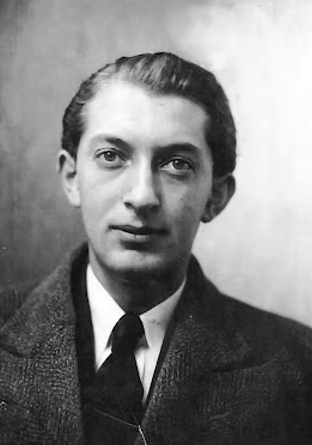
Marina Habe’s father, Hans Habe, led an extraordinary life. Like Sharon Tate’s father, Colonel Paul Tate, Habe also worked in military intelligence and received specialized training during World War II. He was part of the Ritchie Boys, an elite unit of the U.S. Military Intelligence Service made up largely of European émigrés who carried out psychological warfare and interrogation operations against the Nazis.
Born on February 12, 1911, in Budapest, Hungary, Hans Habe (birth name János Békessy) grew up in Vienna after his family relocated there during his childhood. He studied in Germany but returned to Vienna to escape the rising tide of antisemitism. Of Jewish descent, Hans found himself increasingly marginalized as the political landscape darkened.
In the 1930s, Habe established himself as a respected newspaper editor. He also authored several books warning of the rising Nazi threat, which were subsequently banned and burned by the Nazi regime after Austria’s annexation. Forced into exile, he fled to France, where he enlisted in the French Foreign Legion and rose to the rank of sergeant.
Captured in 1940, Habe endured three months in a prison camp before successfully escaping and ultimately immigrating to the United States. After arriving in America, he authored A Thousand Shall Fall, a book about his wartime experiences in France that sold over 3 million copies in 1941.1
Drafted into the U.S. Army in 1942, Hans was trained in psychological warfare. He was deployed to North Africa in 1943, where he participated in Operation Avalanche, the Allied invasion of Italy. During this time, he was responsible for producing propaganda aimed at demoralizing enemy troops and gathering intelligence through the interrogation of German prisoners of war.
By 1944, Hans Habe had become a U.S. Army instructor, training others in psychological warfare and assembling a team of writers to help rebuild the German press as part of postwar reconstruction. He was allowed to handpick those he deemed fit for the job.
In 1945, Habe returned to Germany, where he established over a dozen newspapers in the American-occupied zone, some of which continue to influence the German press landscape to this day. His skills and experience made him a key figure in rebuilding Germany’s press after the war.
During his deployment in 1943, Hans Habe and his then-wife, Eleanor Habe, welcomed a son, Antal Miklós de Békessy.2 Antal, the Hungarian equivalent of the name Anthony, was known as Tony to his friends. Antal was the half-brother of Marina Habe. Former First Lady Eleanor Roosevelt was his godmother.
Born in Manhattan, New York, Antal graduated from Princeton University in 1965. Among other accomplishments, he became a director and advisor to the Metropolitan Museum of Art. He passed away in 2015 in Paris, France. He was buried at Princeton Cemetery and is survived by his daughter, Laetitia Allen Vere.3
Antal’s mother, Eleanor Post Close, was the granddaughter of C.W. Post, the founder of the Postum Cereal Company, which later became the General Foods Corporation. In 1927, Eleanor made her official debut in high society at a formal event called a debutante ball, and the following year she was presented at Buckingham Palace to King George and Queen Mary.
Hans Habe was married four times before meeting actress Eloise Hardt, who became his fifth wife. His third wife was Eleanor, and after their divorce, he married a German actress. In the late 1940s, he met Eloise. Their relationship quickly deepened, and Habe divorced his fourth wife to marry her.
In March 1951, several weeks after Marina Habe’s birth, Hans Habe’s father, Imre Békessy, and his mother, Bianca (née Marton), died by suicide—presumably from a morphine overdose.4 Imre Békessy had reportedly been addicted to morphine since the 1920s and had attempted suicide with it at least three times before. Hans Habe documented his father’s suicidal tendencies in his 1954 book Ich Stelle Mich: Meine Lebensgeschichte.
Imre Békessy—also known as Emmerich—a prominent journalist and publisher, passed on his passion for the press to his son. In the early 1920s, he became a pioneer of tabloid journalism in Austria, founding one of the country’s first tabloid newspapers: sensational, fast-paced, and irreverent in tone, blending political reporting with semi-nude images in a form of sensationalism designed to captivate readers.
Bold and unapologetic, Békessy was a polarizing figure, often accused of blackmail and unethical tactics. His notoriety eventually led to legal trouble. Facing an extortion investigation, Békessy chose not to return to Vienna after a stay in France. He resettled in Paris in 1926 and then moved to Hungary, where he continued his publishing work throughout the 1930s. As Europe grew increasingly unstable, he fled Hungary in 1938 and went into exile in Geneva.
By 1940, Békessy had emigrated to the United States. After World War II, he returned to Hungary, hoping to revive his career, but the postwar Communist regime left no room for his brand of journalism.
In his memoir, Hans wrote that his father’s notoriety led him to change his name to Hans Habe. Hans is the German equivalent of János, his birth name, and Habe is a created surname derived from the initials of Hans Békessy.